
FREE FIELD GUIDE / FOUNDATIONS / ORIGINAL GUIDE & WORKSHEET
A simple household power worksheet
Estimate demand before relying on a battery.
List the devices you really need
Start with lighting, communication and the computer needed to open your information. For essential medical equipment, make a separate backup plan with the equipment provider and care team. This worksheet cannot establish a safe medical backup supply.
Use energy, not just power
For a constant load, watt-hours ≈ watts × hours. A 20-watt light used for 3 hours needs about 60 watt-hours. A 50-watt laptop used for 4 hours needs about 200 watt-hours. Actual demand varies with workload and charging state.
Allow for real-world losses
The battery’s headline capacity is not all available at its outlets. Inverters, converters, temperature, age and reserve settings reduce usable energy. Use manufacturer specifications and a measured trial; do not assume a fixed efficiency applies to every battery.
Check the power limit too
A source with enough energy can still be unable to supply a device’s running or startup power. Check compatible voltage, output ratings, cables and connectors. Never improvise electrical connections.
Keep combustion equipment outside
Fuel-burning generators belong outdoors, far from doors, windows and vents, following current public guidance and manufacturer instructions. Never run them in a home, garage or enclosed space. Use working carbon monoxide alarms. Never backfeed household wiring.
Work a small example before entering the whole household
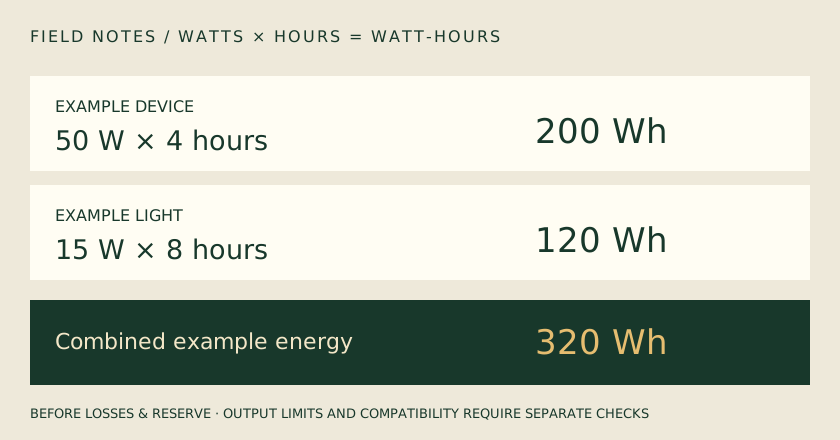
Suppose a device draws a measured 50 watts while operating and you plan to use it for four hours. Its energy estimate is 200 watt-hours. A separate 15-watt light used for eight hours adds 120 watt-hours, making 320 watt-hours before allowing for conversion losses and reserve. These numbers are an example, not a runtime claim for a particular battery or computer. Actual laptop demand can change with workload, screen settings and charging. Use a measured trial with the equipment you will actually carry. Write down the test conditions so a later result can be compared fairly.
Keep capacity, output and charging separate
A battery’s energy capacity, its available output power and the rate at which it can recharge are different limits. A source may have enough nominal stored energy but an unsuitable outlet, connector or power rating. Do not compare amp-hour ratings from different voltages as though they were automatically equivalent energy capacities. Use the manufacturer’s stated watt-hour information and compatible-equipment instructions when available. Do not modify connectors, combine batteries or improvise charging arrangements to make a worksheet balance. If a specification is unclear, obtain appropriate technical advice. This planning sheet is not an electrical installation or battery-construction guide.
Decide the priority order before supplies are low
Make a short list of the devices that support the household’s chosen plan, then identify which can be used less often or for shorter sessions. Separate convenience loads from needs that require a professional continuity plan. For essential medical equipment, coordinate with the provider and care team; a simple percentage reserve or household generator cannot be assumed adequate. Keep a paper contact and route plan so every information task does not depend on starting a computer. Record the changes you could make safely and the assumptions that would have to be checked. Do not let a calculated estimate become a reason to ignore a device warning.
Use a measured runtime log to improve the estimate
Conduct a safe ordinary trial following the equipment’s instructions. Record the source’s starting state, the connected devices, the tasks performed and the elapsed time. Note whether a computer was also charging its internal battery, because that can change the load. Stop the test at the manufacturer’s appropriate limits rather than deliberately exhausting a source or overheating equipment. Record an observed runtime as an observation under those conditions, not a guarantee for a future event. Recheck after equipment changes and significant battery aging. Keep the documented charging and storage instructions with the kit, and leave fuel-burning equipment operation to the relevant safety guidance.
Your worksheet
Device | watts | hours | estimated watt-hours __________________ __________________ Total energy estimate: __________________ Source continuous / surge ratings: __________________ Measured runtime and test conditions: __________________